Social cards for static sites
A link preview (the Open Graph image) is the picture a chat app or social network shows when someone shares a page.
Generating one per page usually means a headless browser or a hosted service. ImageScript renders text, gradients and
photos in plain TypeScript, so a card is a short build script: no browser, no native module, the same pixels on every
machine, and nothing to install in CI besides npm install.
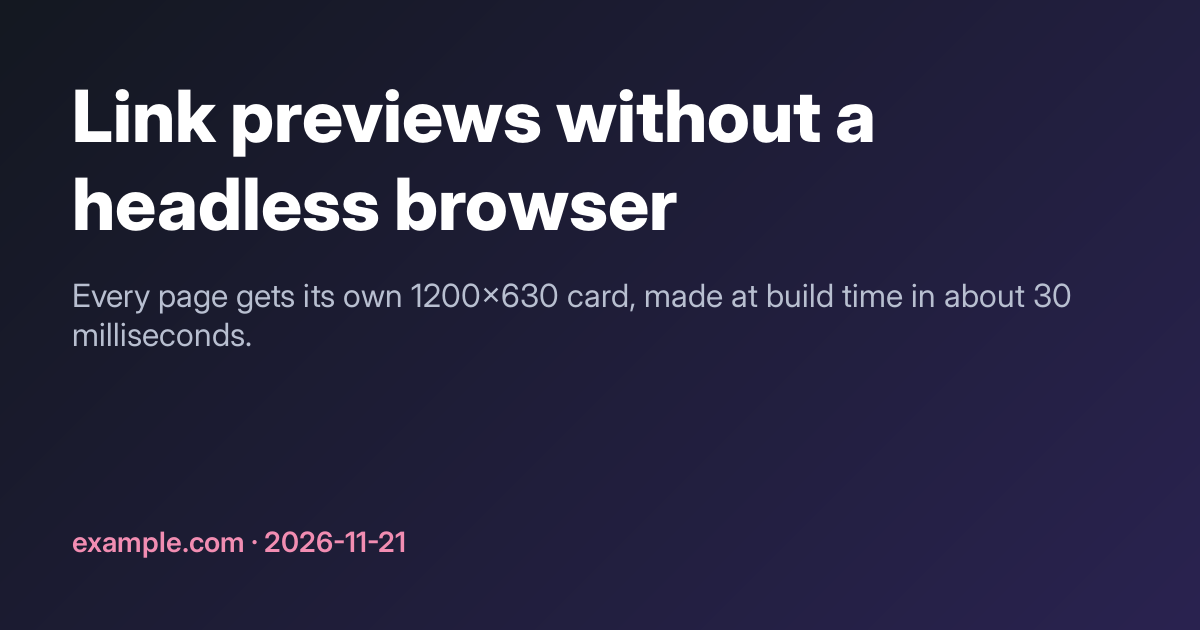
This is a card the script made:
The script
This script writes one 1200×630 card for every Markdown post in content/posts, using the title, description and
date from the front matter. Save it as scripts/social-cards.mjs, put a font in fonts/ (any TrueType, OpenType or
WOFF file; a variable font such as Inter gives the bold weight from one file) and run node scripts/social-cards.mjs.
// One 1200×630 link preview per Markdown post: content/posts/<slug>.md -> public/og/<slug>.png
import { mkdir, readdir, readFile, stat, writeFile } from 'node:fs/promises';
import { Image } from 'imagescript';
const postsDir = 'content/posts';
const outDir = 'public/og';
const site = 'example.com';
// any TrueType, OpenType or WOFF font; a variable font gives the bold weight from the same file
const font = await readFile('fonts/Inter.ttf');
const width = 1200;
const height = 630;
const pad = 72;
// the background is the same for every card: make it once
const stops = [0x141821ff, 0x2a2350ff];
const background = Image.linearGradient(width, height, { stops, angle: 135 });
// front matter: the `key: value` lines between the two `---` lines at the top
function frontMatter(source) {
const block = /^---\r?\n([\s\S]*?)\r?\n---/.exec(source)?.[1] ?? '';
const pairs = block.split(/\r?\n/).map((line) => /^(\w+):\s*(.*)$/.exec(line)).filter(Boolean);
return Object.fromEntries(pairs.map(([, key, value]) => [key, value.replace(/^(["'])(.*)\1$/, '$2')]));
}
async function card({ title, description, date }) {
const image = background.clone();
const footer = await Image.renderText(`${site}${date ? ` · ${date}` : ''}`, {
font, size: 28, color: 0xf28db2ff, variations: { weight: 600 },
});
const summary = description && await Image.renderText(description, {
font, size: 32, color: 0xb8bfd0ff, width: width - pad * 2, height: 100,
});
// the title in the largest size that leaves room for the summary and the footer
const room = height - pad * 2 - footer.height - (summary ? summary.height + 28 : 0) - 28;
let heading;
for (let size = 72; size >= 40; size -= 4) {
heading = await Image.renderText(title, {
font, size, color: 0xffffffff, variations: { weight: 800 }, width: width - pad * 2,
});
if (heading.height <= room) break;
}
image.composite(heading, { x: pad, y: pad });
if (summary) image.composite(summary, { x: pad, y: pad + heading.height + 28 });
image.composite(footer, { x: pad, y: height - pad - footer.height });
// compression level 1 is several times faster than the default, and only a little larger for flat graphics
return image.encodePNG({ compression: 1 });
}
await mkdir(outDir, { recursive: true });
for (const file of (await readdir(postsDir)).filter((name) => name.endsWith('.md'))) {
const slug = file.slice(0, -3);
const target = `${outDir}/${slug}.png`;
// keep the cards that are newer than their post
const [post, existing] = await Promise.all([stat(`${postsDir}/${file}`), stat(target).catch(() => null)]);
if (existing && existing.mtimeMs > post.mtimeMs) continue;
const data = frontMatter(await readFile(`${postsDir}/${file}`, 'utf8'));
const { title = slug, description, date } = data;
await writeFile(target, await card({ title, description, date }));
console.log('wrote', target);
}
A card takes about 30 milliseconds (Node.js 26 on a 2018 laptop CPU), so a site with hundreds of posts is done in seconds. Cards that are newer than their post are skipped, and the title shrinks until it fits the card.
Using it
Run the script before your site's build, for example "build": "node scripts/social-cards.mjs && <your build>", and
point every page at its card:
<meta property="og:image" content="https://example.com/og/hello-world.png">
<meta property="og:image:width" content="1200">
<meta property="og:image:height" content="630">
<meta name="twitter:card" content="summary_large_image">
Changing the design
- A cover photo and an avatar: decode them with Image.decode, size them with resize
(
fit: 'cover'), round them with roundCorners or cropCircle and place them with composite. The Playground has this as the example "Open Graph Card", with a shadow and a glow behind the cover. - Other scripts and emoji:
fonttakes a list; every character comes from the first font that has it, for examplefont: [inter, notoArabic, notoEmoji]. A character that no font has is drawn as a box. - A logo: render an SVG once with Image.renderSVG and composite it onto every card.
At request time
The same card() function works in a request handler on any runtime that runs ImageScript. Mind the CPU time your
platform allows per request: a card like this one needs about 30 milliseconds, which is more than the 10 milliseconds of
Cloudflare Workers' free plan. For a static site, generating the cards at build time has no such limit.